My research combines natural experiments in administrative data with field and lab experiments to understand how individuals make high-stakes financial, labor market, and health care decisions. Current topics I am interested in include understanding plan choice in the Medicare market, self-selection in education investment decisions, and human-AI interactions in consumption, savings, and labor market decisions. My research is generously funded by the National Science Foundation (NSF), the Abdul Latif Jameel Poverty Action Lab (J-PAL), the Fisher Center for Real Estate and Urban Economics, the Law, Economics, and Politics Center at Berkeley Law, the Lab for Inclusive FinTech (LIFT), the Opportunity Lab at UC Berkeley, the Robert Wood Johnson Foundation, the National Endowment for Financial Education (NEFE), and the Commonwealth Fund.
Working Papers
2026
Working Paper
The Price of “Free” Advice: Measuring Agency Problems in the Insurance Broker Market
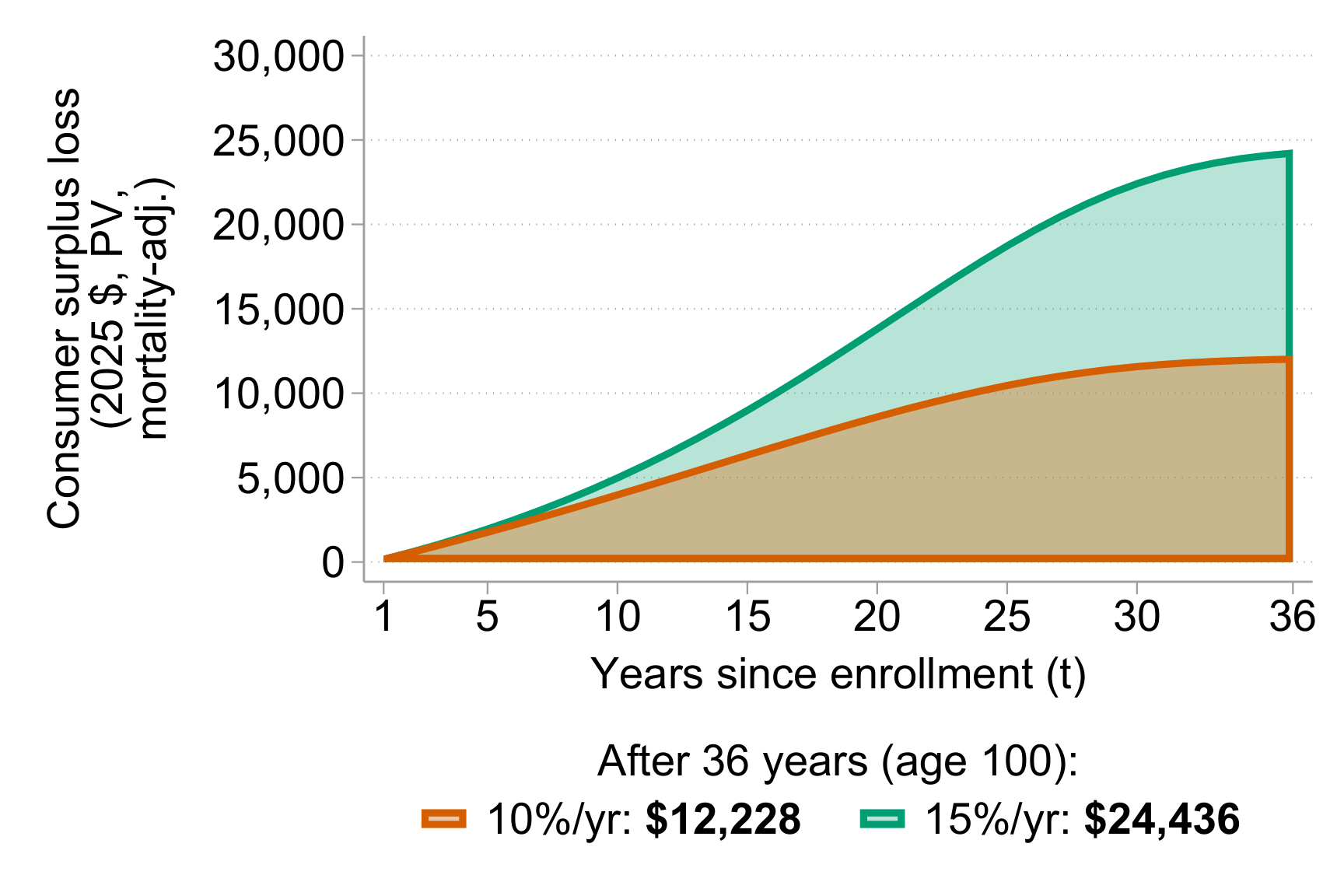
Governments rely on private intermediaries to help people navigate complex public programs, but the information frictions that make expert advice valuable can also prevent consumers from evaluating its quality. We study how commissions, competition, and information frictions shape agency problems in Medicare, a federal health insurance program serving nearly 70 million seniors and people with disabilities. In a large-scale audit study, we hire 109 senior “secret shoppers” to make 637 calls to randomly assigned brokers. Brokers steer seniors toward a higher-commission plan in 52% of calls, and advice quality varies by broker characteristics. Dominated recommendations carry a 29% premium markup, costing seniors $377 per year and over $12,000 in present-value lifetime wealth. A natural experiment that eliminates broker commissions reduces steering to the higher-commission plan by 21 p.p. but does not eliminate steering. A randomly assigned treatment designed to increase perceived competition, by signaling that seniors will seek multiple recommendations, causes brokers to recommend lower-priced plans. This increases consumer surplus when plans are homogeneous, but decreases it when plans differ in coverage. A structural model shows that supply-side reforms, such as equalizing commissions and capping premium markups, generate larger consumer surplus gains than consumer-side policies such as ratings feedback and increased competitive pressure. The findings show that when consumers cannot evaluate expert advice, competitive pressure can shift recommendations without necessarily aligning them with consumer interests, highlighting the importance of well-designed intermediary incentives.
Working Paper
Dollars and Sense: Self-Selection in Financial Literacy Education
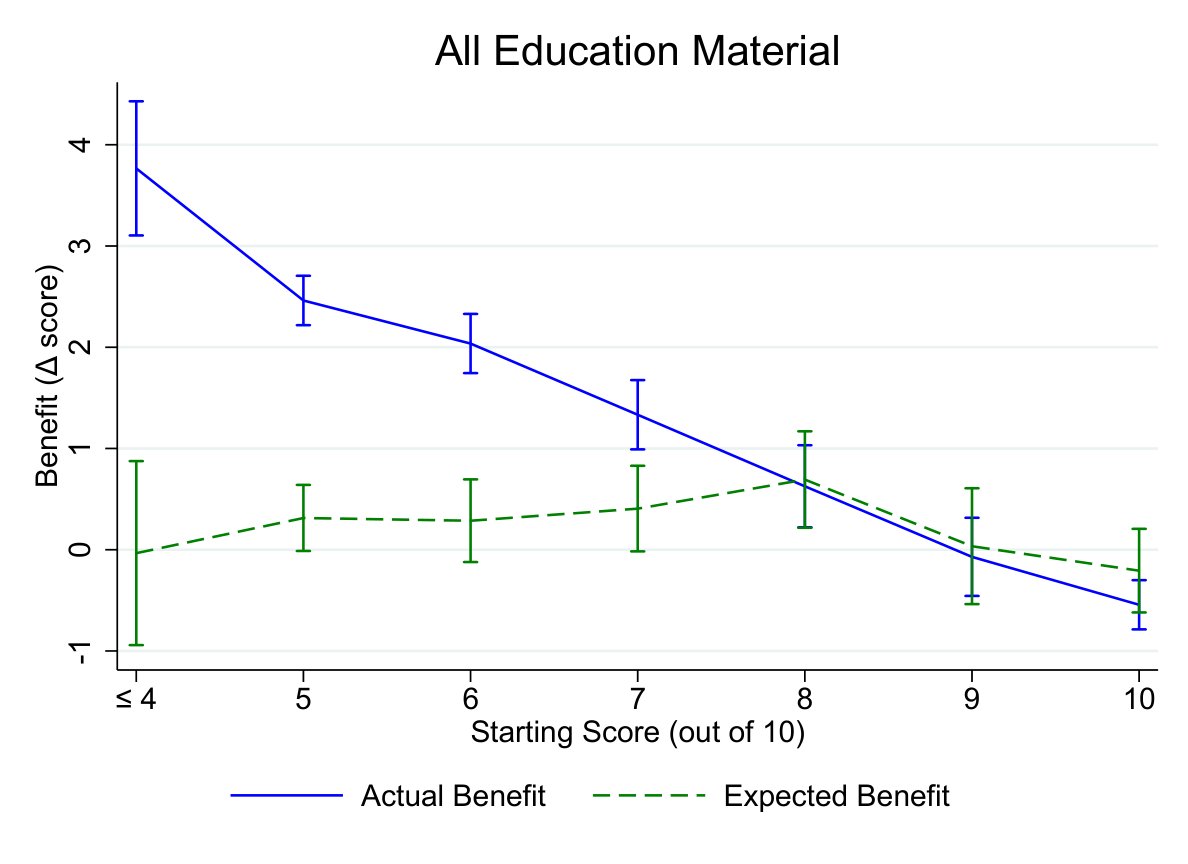
Standard models of human capital investment predict that individuals self-select into education based on its expected returns, yet the individuals who stand to benefit most may face frictions that discourage investment. This paper studies this tension in financial literacy education. First, we combine evidence from a university personal finance course linked to credit panel outcomes, a student financial decision-making survey, and an online experiment to document positive selection into financial education: demand for financial education is positively correlated with baseline financial knowledge and financial strength. Second, to test whether there is selection with respect to marginal returns, we use a controlled online experiment (n = 1,045). We show that individuals systematically mispredict the returns to education; expected gains are approximately flat across baseline knowledge, while realized gains decline sharply with baseline knowledge. Finally, we experimentally vary instructional format to test whether technology-backed education can change selection patterns by reducing perceived cognitive costs. We find that AI- and video-backed education increase demand for financial education relative to traditional lecture-style instruction, but fail to change selection patterns. Our findings highlight a disconnect between educational returns and demand, suggesting that financial education interventions may fail to close knowledge gaps without addressing underlying frictions.
Working Paper
Deadpooling: Strategic Adverse Selection in the Medigap Market
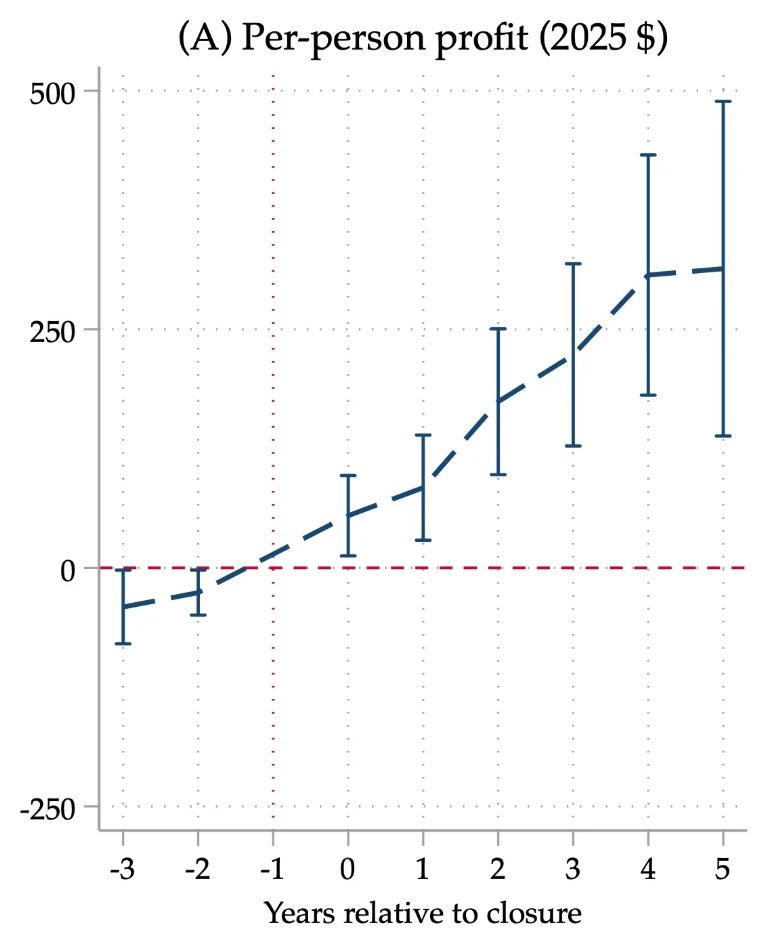
This paper studies how firms use subsidiaries to circumvent regulations and profit off inattentive consumers. Linking two decades of Medicare Supplement filings to annual parent–subsidiary ownership records, we document “deadpooling”, a novel financial practice where insurers use corporate structure to circumvent regulation and extract rents from high-risk consumers in the Medicare Supplement market. We find that 17.6% of Medigap life-years through 2020 are spent in plans that deadpool, and each year’s closures transfer an additional $64.7 million from seniors to insurer profits over the following five years. This extraction is a choice rather than an accounting response to an aging beneficiary pool. Using a natural experiment in which a federal statute effectively closed some plans to new enrollment, we find that deadpooling plans with identical coverage reprice much more aggressively than plans that slowly age in place. Harm to consumers accrues through increased payments to insurers, switching costs, and the change in consumer surplus from beneficiaries priced out of the market. We estimate total harm to be $129.4 million for each year’s closures over the following five years and that each dollar of deadpooling markup collected by insurers costs seniors $2.00. We find that expanding switching rights, an intervention that would eliminate this harm in a market with perfectly rational consumers, only reduces deadpooling by 18%. We explain this finding as a consequence of consumer inattention using a demand-side simulation. We examine alternative solutions that do not rely on consumer attention and find that these reduce harm by up to 53%, against a 5% harm reduction from expanded switching rights.
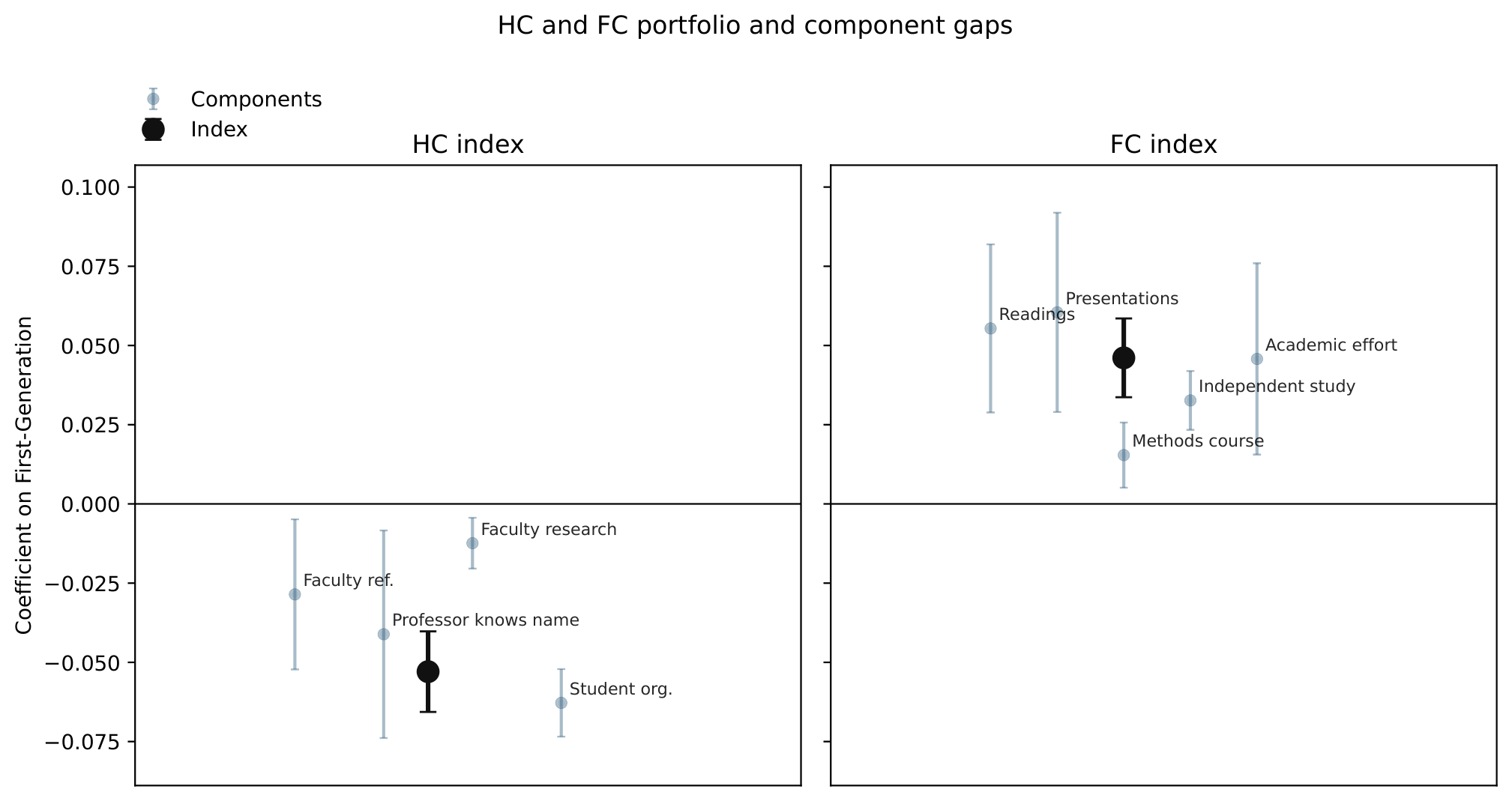
Despite expanded access to selective colleges, first-generation students often trail their peers in educational and early-career outcomes. We study one mechanism: the hidden curriculum—implicit, unwritten practices critical to educational and career success such as networking. First, we use data from over 70,000 students across 20 public universities to identify a first-generation gap in investment in hidden-curriculum actions. Second, in a field experiment at UC Berkeley, we show an information intervention increases take-up of hidden-curriculum actions by 13pp, closing roughly 77% of the baseline gap. Finally, an online experiment with AI college advisors shows that first- and continuing-generation students exert similar information acquisition effort, but respond differently to hidden-curriculum nudges. Proactive information about returns eliminates this gap. The results highlight that asymmetric information about potential strategies and returns may prevent equal access from delivering equal opportunity and equal outcomes.
Work in Progress
2026
Work in Progress
Money Therapy: AI Advice and Financial Decision-Making
This project investigates a novel friction in household finance: the absence of “self-knowledge” or self-awareness of financial behavior. While existing fintech budgeting apps typically target information gaps through dashboards or self-control failures through commitment devices, we explore whether AI-mediated self-reflection can causally reduce discretionary spending by encouraging self-reflection and helping users construct persistent narratives around their financial lives. In partnership with an AI-backed personal finance application, we utilize an observational event study using high-frequency transaction data alongside a randomized controlled trial. Our experimental design isolates the mechanism of self-knowledge by comparing a self-reflection, narrative-framed AI intervention against both an active, information-only AI control and a delayed-access group. By analyzing chat transcripts and longitudinal surveys, the study seeks to determine if self-reflection and increasing self-knowledge can improve saving and budgeting behavior and financial well-being more than traditional information- or commitment-based approaches.
Work in Progress
Overconfidence and Information Seeking: Implications for Financial Decision-Making
Individuals frequently make costly financial mistakes while expressing high confidence in their financial knowledge. Does overconfidence inhibit information acquisition and thereby lead to suboptimal financial decisions? We study this question in a field experiment. First, we document that participants are substantially overconfident about their knowledge related to debt. Then, we experimentally reduce confidence in a randomly selected group using an Illusion of Explanatory Depth (IOED) intervention that reveals gaps in their knowledge, while a control group receives a placebo exercise that does not affect confidence. After the intervention, all participants are offered access to an educational resource. We test whether lowering confidence increases information take-up and leads to improvements in financial outcomes.
In recent years many firms have begun using personality assessments to screen job applicants; however, the effectiveness of such screens has not been tested. We study the effectiveness of these tests using proprietary data from a large personality assessment provider.
Technological progress has historically favored high-skill labor, widening income inequality. Generative AI offers a potential counter-force: it can de-skill tasks like writing cover letters or optimizing resumes, theoretically benefiting low-skill job seekers the most. However, the realized impact depends on adoption. We combine observational data with a field experiment among active job seekers to investigate whether those who need AI assistance the most are the ones who use it. Similar to other surveys on AI usage, we expect to find an “adoption mismatch” where low-income and less-educated individuals—who face higher turnover and structural vulnerability—are significantly less likely to adopt AI job search tools than their high-skill counterparts. To separate selection from treatment effects, we plan to employ a two-stage design: we first offer an AI tool to all participants, then randomize financial incentives to induce uptake among those who initially declined. This allows us to estimate treatment effects for “reluctant adopters.” We will then examine whether exposure to AI job search tools changes beliefs about the usefulness of AI. We also test whether AI assistance reduces unemployment duration and increases wage offers and compare differences between the “voluntary adopters” group and the “forced adoption” group. Finally, we analyze the interaction logs of the AI job search tool to examine the extent to which high and low-skill job seekers override high-quality algorithmic suggestions, reverting to suboptimal text. Our results will highlight how differential selection may lead AI tools to widen labor market inequalities rather than narrow them.
Work in Progress
The Long-Term Impact of Financial Literacy: Evidence from Community College
Private insurance companies and call centers use advertising and marketing materials to attract new Medicare enrollees, but little is known about how these firms target and persuade consumers. Using Nielsen Ad Intel data, we document that private insurers and call centers concentrate their advertising in lower-income, less-educated regions. We plan to supplement this analysis with the ad filings insurers are required to submit to state departments of insurance offices to study the persuasion techniques firms use and to examine how advertising exposure maps to plan choice and broker use.
Pre-PhD
2018
EJPE
A clear advantage: The benefits of transparency to crisis recovery
Increasing transparency is one of the first and most common recommendations from international financial institutions to policymakers in countries that experience economic crises. Despite the widespread prescription of this elixir, disagreements persist about its efficacy during crises. Much of the existing literature suggests that increasing transparency decreases information asymmetries, increases policy predictability and the credibility of policy commitments, improves the effectiveness of monetary policy, and bolsters public confidence. Each of these effects could plausibly shorten the duration of economic crises. Critics counter, however, that effects of transparency are ambiguous and may increase policy uncertainty, raise volatility, increase the prospect of collectively self-destructive behaviors, and decrease the effectiveness of monetary policy—effects that could prolong crises. These debates persist in part because related empirical research tends to focus primarily on the transparency of central banks and its impact on market expectations regarding short-term interest rates without considering the transparency of national governments and how the availability of credible data about the national economy from sources other than the central bank affects public and market expectations. We argue that greater transparency of national governments—often inferred from, yet independent of, the transparency of central banks—will decrease the duration of inflation and currency crises by providing information about existing economic conditions, increasing the predictability and credibility of national economic policy, and increasing confidence in the efficacy of policy choices by demonstrating the degree to which the policy positions of national politicians and central bankers align. We operationalize government transparency in terms of the government dissemination of credible macroeconomic information using the Hollyer, Rosendorff, and Vreeland (HRV) index. Our analyses of 125 countries from 1980 through 2010 indicate that higher levels of government transparency are strongly correlated with shorter durations of inflation and currency crises and that the level of transparency is negatively correlated with the severity or size of inflation crises.
Industry
Insurers and Green Bonds, an Entry Point into Sustainable Investing
 The Price of “Free” Advice: Measuring Agency Problems in the Insurance Broker MarketPresentations: ASSA 2027, SEA 2026, SITE 2026, NBER Summer Institute 2026
 Dollars and Sense: Self-Selection in Financial Literacy EducationDraft available upon request.Presentations: SEA 2026, BEAM 2026, Stanford Financial Education Symposium 2026